Nkele’s Mirror
By late afternoon, the mist from the upper falls had reached the market terraces.
It came down in thin, wandering veils between the high bridges, gathered on the leaves of the courtyard trees, and made the stone steps shine even where nobody had washed them. Below, New Kongo was finishing its day's work. Delivery carts trundled along the lower arcade. Someone in a workshop was testing a cutting machine whose every third pulse made the cups rattle on Nzitani's table. Above the waterfalls, the slender towers stood in the pale gold of the declining sun, connected by bridges so fine that a visitor might have mistaken them for lines drawn on the air. Two observation towers hung beyond the eastern gardens, suspended above the routes into the city. From their open decks the watchkeepers could see the transit bridges and the water catchments without laying another road across the terraces. A mango tree had grown through the old stone rail of the nearest gallery; no one had moved it. They had built a new handrail around the trunk.
Nzitani had spent most of the day in uniform. A regional command review had run into the afternoon; then two neighboring families had asked the House of Nzinga to intervene in a dispute over a retaining wall that carried part of their shared irrigation system. They brought documents, measurements and a considerable quantity of resentment. By the time Nzitani reached them, a workman repairing the channel had fallen against a broken fastening and torn an artery in his forearm.
She did not restore him with a gesture. She knelt in the wet earth beside the medical team, asked for the vascular image and watched the branching structure illuminate the physician's portable display. She understood this injury: precisely where the vessel had opened, which tissues had lost perfusion, what pressure the damaged wall could bear. The physician secured the wound. Nzitani helped guide the living process at its narrowest, keeping tissue viable while the repair took hold. When the man's hand warmed again, she withdrew before the surgeon had finished checking it.
"Don't bend it because it feels better," she told him.
"I wasn't going to."
She glanced at the tools lying beside him.
"You already did once."
He looked sheepishly at the physician, who gave a small, exhausted nod.
Nzitani was the Great Protector of Life, general of the House of Nzinga and its head. Those titles had not shortened the afternoon. She still had to listen to the neighbors explain why the same stone belonged to both of them. She appointed a joint inspection at first light, then walked home with the sharp ache that came when she had held herself composed for too many hours.
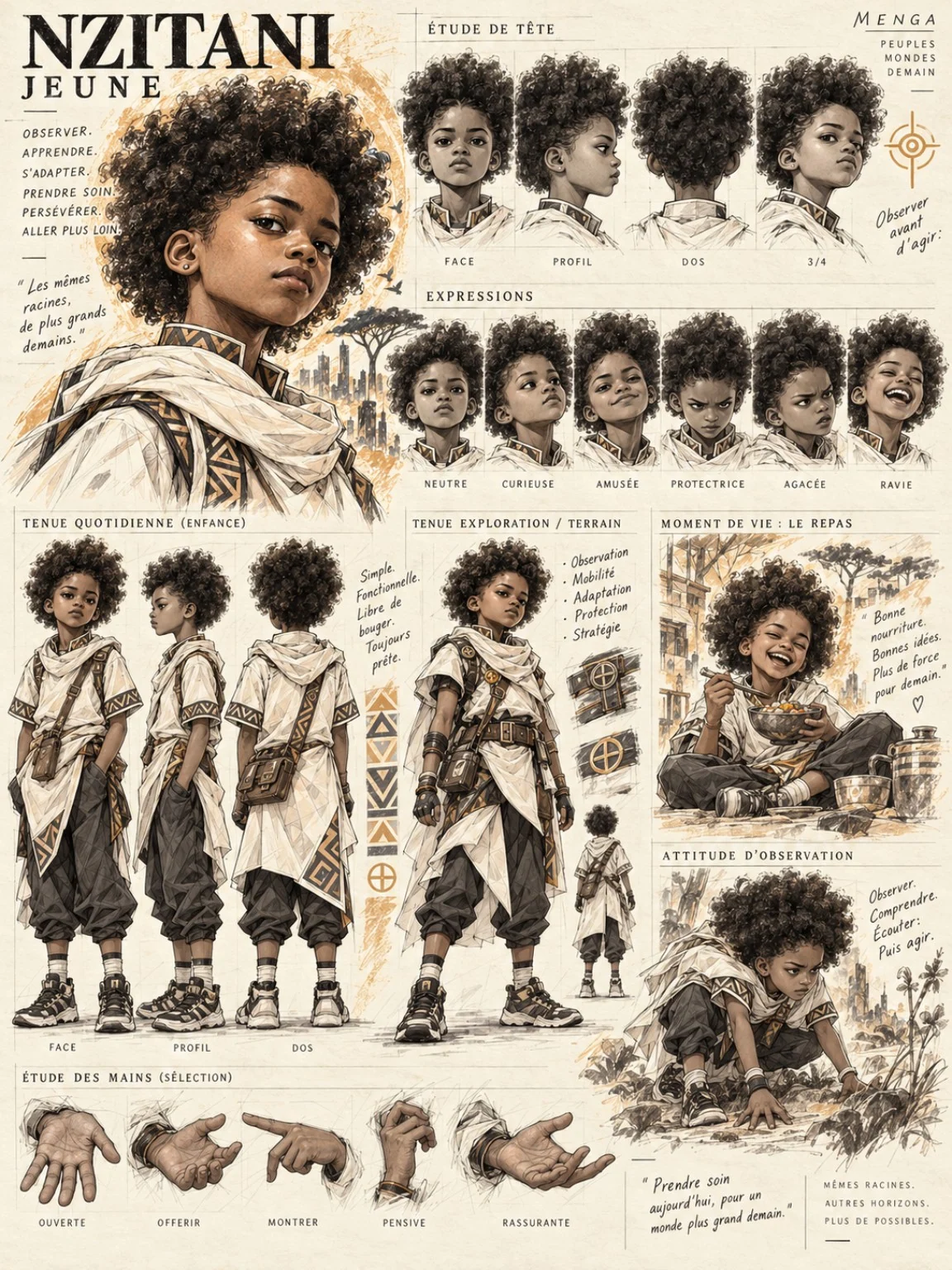
She arrived at the veranda without the armored breastplate of her field uniform. Under the loose cream overshirt her shoulders retained its memory. Her dense black afro had escaped its fastening and spread into a broad, magnificent silhouette above her narrow gold headband. She had a strong, expressive face, alert dark eyes and an impatient little line at one corner of her mouth that her friends recognized as the warning she was too tired to be diplomatic. Two delicate nicks marked the backs of her hands. She had not noticed them until she reached for the bench.
She set her bag beneath it, removed the band from her wrist, and stretched her aching fingers.
"You look as though the wall won," Konzo said.
He had arrived without announcing himself. Konzo wore his dark, tightly curled hair short enough to clear his collar; the small beard framing his face was less orderly after a day's work. His jacket lay over one shoulder, and a pale line of field dust ran down the side of his neck. His warmth showed first in his eyes, though the rest of him was made for difficult terrain and harder decisions. He set a paper bag beside her cup.
"The wall has excellent representatives," Nzitani said.
"Did anyone ask the wall what it wanted?"
"Tuti would have."
"Tuti would have charged it with refusing to cooperate."
Nzitani opened the bag. Inside were two warm cakes wrapped in leaves, their edges darkened by the oven. One had already been broken.
She looked up.
"You ate my cake."
"I checked that it was safe."
"Half of it?"
"The danger was difficult to assess."
She held his gaze until he smiled, then drew the second cake toward herself. Konzo sat down beside her with the unceremonious relief of a man who had been on his feet since morning.
Konzo had taken one bite when a voice behind him said, "So that's where her cake went."
He stopped chewing. Nzitani kept her eyes on her food, although the corners of her mouth had already begun to betray her.
"Good evening, Tuti," Konzo said.
"Good evening. Did you buy that for my sister?"
"Yes."
"And then eat it?"
"Part of it."
"Interesting courtship."
Tuti stood by the doorway, lean and restless, his shaved head catching the last clean light from the west. The light at his fingertips—he had been idly rolling a little strand of it between finger and thumb—went out when Nzitani looked up. He was still wearing the pale, patterned armor he preferred on working days, though the dust on one shoulder suggested he had found a reason to spend the morning somewhere less civilized than the courtyard.
"Leave my cake alone," Nzitani said.
An opening passage from the Chapter 01 source text. The story continues beyond this free selection.
Keep exploring
Go further into Afro-fantasy, or discover the next free reading.
Explore Afro-fantasy →More free reading →Meet the characters →